What is the MegaSoTL-AI initiative?
Started in 2023, MegaSoTL-AI is a multi-institutional, cross-disciplinary research-to-practice initiative focused on artificial intelligence (AI) in teaching and learning. We facilitate research connections amongst faculty, staff, postdocs, and graduate students across institutions and develop resources and professional learning opportunities for higher education instructors across Virginia and beyond.
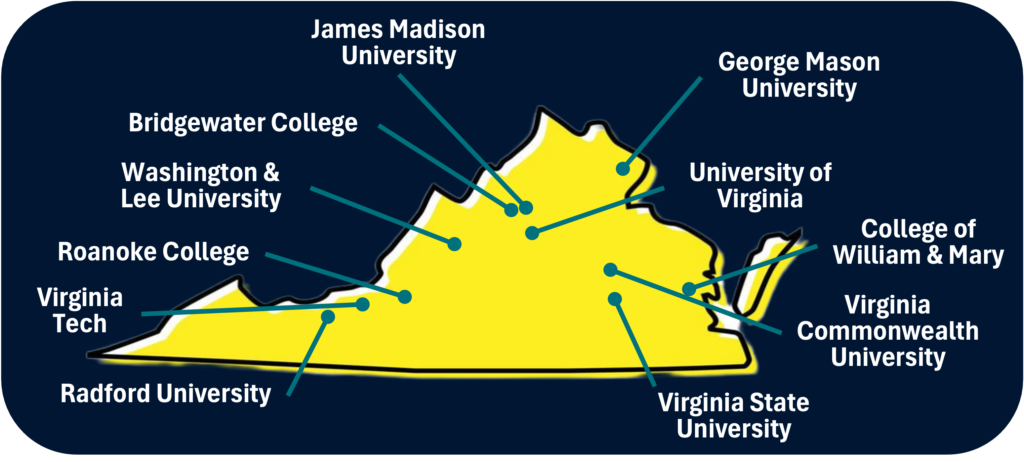
The initiative is led by three co-principal investigators: Breana Bayraktar (George Mason University), Dayna Henry (James Madison University), and Jessica Taggart (University of Virginia) and has involved 50+ team members across 10 institutions. Our work has been supported by a $93,000 Fund for Excellence and Innovation grant from the State Council of Higher Education for Virginia.
Current Projects
- A Framework for AI-Related Teaching Choices
- Team led by Kiera Allison (Assistant Professor, McIntire School of Commerce, UVA)
- Fall 2023 – Present
- This project explores how instructors across disciplines are experiencing, and adapting to, the impacts of AI on college writing. It seeks, moreover, to contextualize those adaptations within broader trajectories of curricular disruption and change. The project sheds light on the wide range of ways AI is integrated into, resisted within, or catalyzing change across various writing-inclusive disciplines.
- AI-Influenced Feedback Practices
- Team led by Breana Bayraktar (Educational Developer, Stearns Center for Teaching and Learning, GMU)
- Fall 2025 – Present
- This project involves two phases: Phase 1 will explore the impacts of AI on how instructors provide feedback to students and how instructors help students understand how to interpret/respond to feedback. Phase 2 will explore the impacts of AI on student responses to feedback.
- Enhancing Students’ Ethical Use of GenAI Tools through AI Literacy Activities
- Team led by Amanda Bryan (Assistant Professor, English, GMU)
- Fall 2023 – Present
- This project is designing, testing, and revising a set of AI literacy “onboarding” activities meant to enhance students’ AI literacy and ethical use of GenAI tools.
- Evaluating Student–AI Collaborations in Higher Education
- Team led by Kiera Allison (Assistant Professor, McIntire School of Commerce, UVA)
- Fall 2023 – Present
- This project investigates the challenges of assessing student–AI collaborations and the redefinition of the unit of learning and work. Through iterative assignments, the study engages students directly in the assessment process to explore in what ways they perceive their roles and contributions within AI–assisted projects. Analysis of student perspectives surfaces critical questions about whether we should evaluate individual contribution or collaborative achievement, and about how to reconceptualize excellence, distinction, and rank in an era of distributed cognition.
- Integrating GenAI and Ethical Reasoning into the Engineering Design Process
- Team led by Esther Tian (Associate Professor, School of Engineering, UVA)
- Fall 2025 – Present
- This project will develop, implement, and evaluate instructional modules and case studies that integrate generative AI use and ethical reasoning into the engineering design process, addressing an urgent pedagogical gap as AI reshapes engineering practice. These educational resources will be co-designed with fourth-year engineering students and piloted with first-year students at UVA and JMU, enabling authentic and diverse perspectives that will enrich the resources and make them broadly applicable across contexts.
Completed Projects
- AI-Based Feedback and Its Influence on Academic Growth
- Team led by Spyros Simotas (Assistant Professor, French, UVA)
- Fall 2023 – Spring 2025; Dissemination Ongoing
- This project explored the impact of AI-generated feedback on students’ confidence and growth mindset about writing. Results revealed that GenAI can support meaningful learning gains when paired with critical reflection and instructor guidance, and student responses to the tool span the spectrum between enthusiasm and skepticism.
- Development and Evaluation of an OER, Fostering AI Literacy: A Guide for Educators in Higher Education
- Team led by Fang Yi (Assistant Director, Learning Design & Technology, UVA) and Bethany Mickel (Teaching and Instructional Design Librarian, UVA)
- Fall 2023 – Spring 2025; Dissemination Ongoing
- This project resulted in the creation of Fostering AI Literacy: A Guide for Educators in Higher Education, a new open educational resource (OER) designed to support higher education instructors as they navigate the rapidly changing landscape of generative AI in teaching and learning. This resource features interactive content, specific classroom examples, reflection questions, and hands-on activities to help faculty develop AI literacy and make intentional, informed course design decisions that cultivate students’ AI literacy. The team conducted several surveys with instructors across the state to inform design, development, and ongoing revision.
- Exploring Generative AI Use and Perceptions Among Students with and Without Disabilities in Higher Education
- Team led by Danielle Waterfield (PhD Candidate, School of Education and Human Development, UVA)
- Fall 2023 – Spring 2025; Dissemination Ongoing
- This project examined how students with and without disabilities use and perceive GenAI in their academic work. Results highlight both the opportunities GenAI offers for accessibility and support, as well as ongoing concerns related to ethics, reliability, and equitable implementation in higher education settings.
- Instructor Responses to GenAI in Classroom Assessment
- Led by Rip Verkerke (T. Munford Boyd Professor of Law and Director of the Program for Employment & Labor Law Studies, School of Law, UVA)
- Fall 2023 – Spring 2025; Dissemination Ongoing
- This project examined faculty attitudes towards AI tools and the strategies instructors have adopted in response to their availability.
How can I get involved?
Potential roles for collaborators include
- Contribute to development of teaching + learning resources
- Participate in the design of future research studies, including: research questions being investigated, data collection instruments, and/or data analysis plan
- Contribute to data collection in your courses (this may involve disseminating surveys, collecting student artifacts, coordinating interviews or focus groups with students, coordinating with class observations, and other data collection activities)
- Contribute to data collection in colleagues’ courses (this may involve conducting interviews or focus groups with students, conducting class observations, and other data collection activities)
- Contribute to analysis of the data collected by the research team
- Contribute to publication/presentation of findings
How did this MegaSoTL project develop?
MegaSoTL projects are scholarship of teaching and learning (SoTL) projects that generate evidence of learning from multiple institutions.
Read about “MegaSoTL: Supporting pedagogical research across multiple institutions“

Recent Events
Virginia AI Symposium: Advancing Teaching and Learning in the Age of Generative AI
The Virginia AI Symposium: Advancing Teaching and Learning in the Age of Generative AI was a day-long, multi-modal, cross-institutional event that brought together over 360 instructors, educational developers, staff, administrators, and students from 50 institutions to explore the potentials and pitfalls of generative AI (GenAI) in teaching and learning in higher education.
The symposium functioned as a key dissemination outlet for the MegaSoTL-AI initiative and was designed to support intentional, research-informed decision-making about GenAI’s evolving role in teaching and learning in higher education, and to foster cross-institutional dialogue in this domain. The symposium included a keynote, interactive sessions, and research presentations that translated emerging scholarship into actionable classroom practices. To maximize access and participation, both an in-person and a virtual track were held, with a shared, livestreamed keynote followed by unique sessions in each track.